


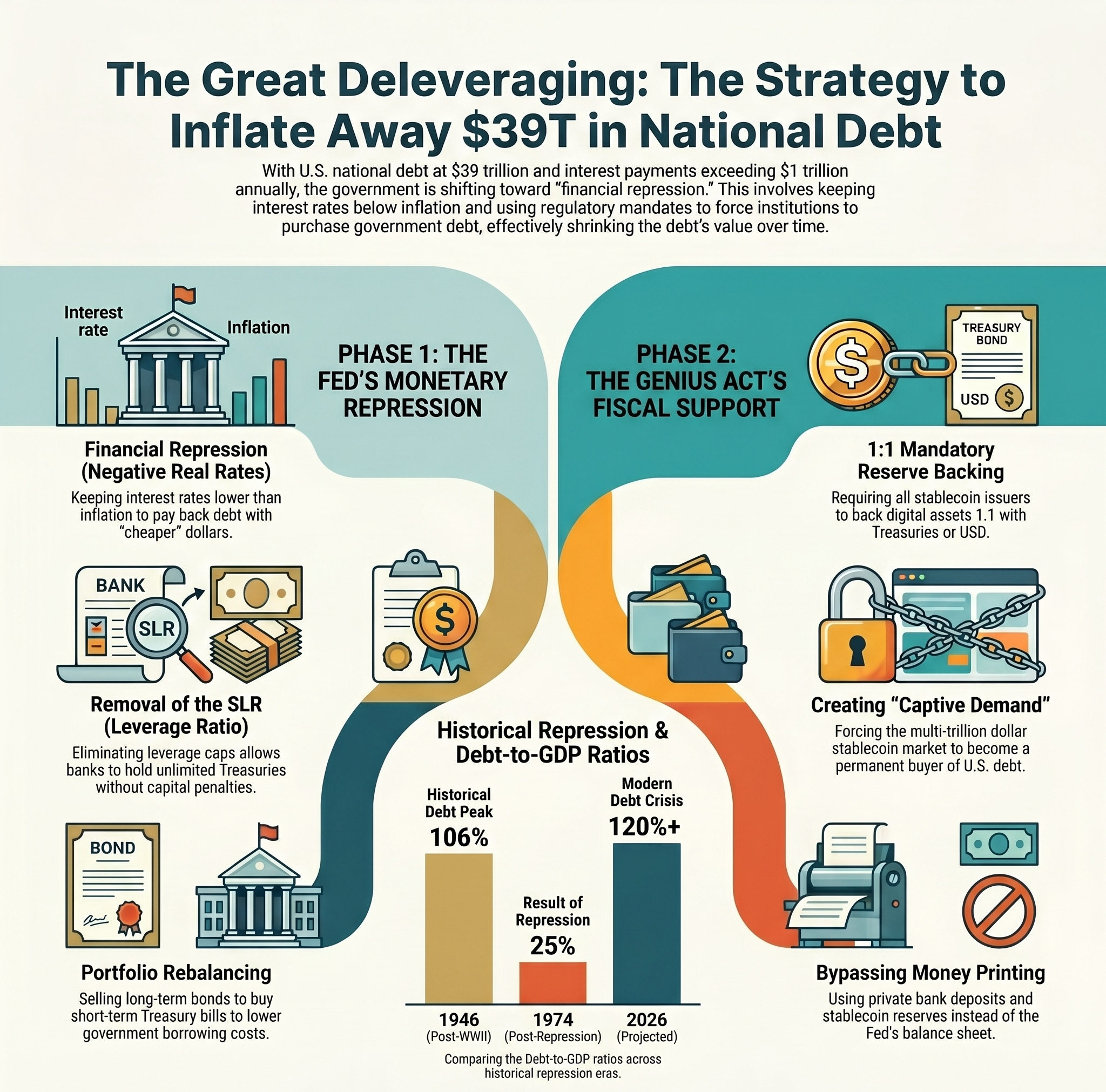
We must confront the reality that the era of standard, independent monetary policy has concluded. The Federal Reserve, in concert with the Treasury, has shifted toward a coordinated “financial repression” strategy—a deliberate policy regime used to reduce the federal debt-to-GDP ratio through a combination of engineered inflation and capped nominal interest rates. As defined by the Levy Economics Institute, this allows the sovereign to shrink the real value of its obligations while keeping borrowing costs below the rate of price increases.
This article provides a companion analysis to our audio feature, detailing how the new Fed Chair’s yield-capping directive and the July 2025 Guiding and Establishing National Innovation for U.S. Stablecoins (GENIUS) Act function as a unified framework. Together, these tools are strategically positioned to manage the $23.1 trillion in cumulative deficits projected over the coming decade.
The Fiscal Cliff: Why ‘Business as Usual’ Ended
The necessity for this aggressive shift is dictated by the Congressional Budget Office’s (CBO) latest outlook, which depicts a fiscal trajectory that CBO Director Phill Swagel has explicitly termed “not sustainable.” The 2025 legislative landscape—specifically the 2025 Reconciliation Act, which increased projected deficits by $4.7 trillion, alongside shifts in tariff and immigration policy—has forced a radical rethinking of the baseline.
Key data points from the CBO’s 2026–2036 outlook include:
The 2026 Projected Deficit: $1.9 trillion, or 5.8% of GDP.
Debt held by the Public: Projected to reach 120% of GDP by 2036 and a staggering 175% by 2056.
Net Interest Outlays: The explosion of debt service costs from $1.0 trillion in 2026 to $2.1 trillion by 2036 (rising from 3.3% to 4.6% of GDP).
The Productivity Wildcard: While the CBO incorporates a 10-basis point annual productivity boost from generative AI, the sheer volume of debt outpaces even this technological dividend.
The Strategy: Defining the New Financial Repression
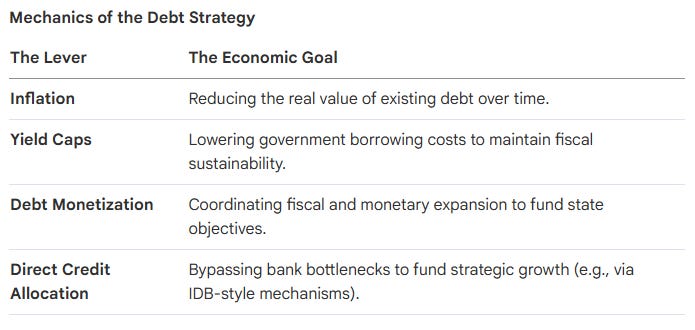
The current Fed Chair is executing a two-pronged strategy: eroding the real value of federal debt via intentional inflation while capping Treasury yields to prevent interest outlays from paralyzing the budget. This is not without precedent. The Levy Economics Institute’s study of Canada (1935–1975) demonstrates how a central bank can engage in “monetary financing” to support fiscal expansion and industrialization without immediate hyperinflation. A key mechanism in that era was the Industrial Development Bank (IDB)—a central bank subsidiary that provided direct credit to businesses, effectively bypassing traditional credit constraints.
The GENIUS Act: Creating the ‘Artificial Buyer’
The GENIUS Act of July 2025 is the primary regulatory instrument for creating “massive artificial demand” for U.S. debt. By establishing a “Limited Federal Bank Charter,” the Act allows non-bank fintech firms to issue “payment stablecoins”—digital bearer instruments that function as a cash substitute.
The Act co-opts these issuers into the Treasury’s service through two critical technical mechanisms:
1-to-1 Backing Requirement: Stablecoins must be backed 1-to-1 by liquid, low-risk assets, specifically short-term U.S. Treasuries and currency.
Skinny Master Accounts: The Fed provides these non-bank issuers with limited access to its payment rails. These “skinny” accounts allow direct settlement in central bank money but are restricted: they cap balances, pay no interest, and lack daylight overdraft or discount window privileges.
This framework transforms the stablecoin market—which grew from $25 billion in 2020 to over $273 billion in 2025—into a price-insensitive pool of Treasury buyers. With market estimates reaching $3 trillion by 2030 (and cross-border payment volume projected between $2.1 and $4.2 trillion), the GENIUS Act ensures a mandatory backstop for federal debt as the Fed attempts to cap yields.
Competitive Dynamics: Stablecoins vs. Traditional Banking
The GENIUS Act creates a sharp distinction between digital instruments, emphasizing the “singleness of money”—the requirement that $1 in stablecoins remains interchangeable with $1 in fiat at par. Failure to maintain this interchangeability poses a macro-stability risk, potentially “breaking the buck” and disrupting the payment system.
Backing: Stablecoins use 1-to-1 low-risk assets in segregated accounts. Tokenized deposits are backed by the bank’s balance sheet and FDIC insurance.
Native vs. Representation: Strategists must distinguish between “tokenized deposits” (digital representations of existing accounts) and native “deposit tokens” (on-chain assets settled directly on the ledger).
Yields: The GENIUS Act explicitly prohibits issuers from paying interest to users. This is intended to ensure stablecoins remain a “medium of exchange” rather than an investment vehicle, though it may drive users toward “tokenized money market funds” for yield.
Risks and Global Consequences
The shift to a financial repression regime introduces severe unintended consequences that could undermine the very stability it seeks to preserve.
Seigniorage Loss and Fiscal Neutralization: As stablecoins reduce the demand for physical currency, the Federal Reserve’s profits—traditionally returned to the Treasury—shrink. If the loss of seigniorage exceeds the savings from lower interest rates, the “artificial buyer” strategy becomes a net fiscal negative.
Illicit Finance and the ‘Digital Cash’ Risk: As bearer instruments, stablecoins facilitate anonymous transfers. Regulators are considering a “global registry of trusted counterparties” to manage AML/CFT risks, but the “always-on” nature of these assets makes enforcement difficult.
Global Dollarization and Sovereignty: Proliferation of USD stablecoins abroad threatens the monetary sovereignty of foreign nations, who may ban these instruments to protect their own seigniorage and policy control.
The 24/7 Liquidity Mismatch: Stablecoins trade and redeem 24/7/365, while the underlying Treasury market remains tied to traditional banking hours. This creates a dangerous window for redemption failures and runs during weekends or holidays when reserve assets cannot be liquidated to meet “always-on” demand.
A New Era of Monetary-Fiscal Coordination
The GENIUS Act is not merely a crypto-regulation bill; it is a fundamental pillar of modern U.S. debt management. By integrating the fintech sector into the national fiscal defense, the government has created a mandatory ecosystem for Treasury absorption.
This marriage of regulatory clarity and fiscal necessity marks the definitive end of “central bank independence” as understood in the late 20th century. We have entered an era of explicit coordination, where the Fed and Treasury work in tandem to prevent a federal debt crisis through the controlled, calculated application of financial repression.


