


The 2026 Climate Paradigm: The Advent of the Super El Niño
The global climate system has reached a terminal state of acceleration, with 2025 establishing a thermal baseline that forces a recalibration of all existing risk models. This is no longer a cyclical fluctuation; we are witnessing the advent of the most powerful El Niño event in 140 years of instrumental observation, landing upon a troposphere already saturated with anthropogenic heat. From an environmental audit perspective, this represents a massive discharge of a “global heat battery” that has been recharging at a human-accelerated rate. Senior climatologist James Hansen has observed that human-induced warming is fundamentally decreasing the time required to “recharge” the Pacific’s thermal stores, suggesting that the interval between these catastrophic discharges is narrowing.
Indicators of Global Climate Acceleration (2025 Audit Baseline):
Greenhouse Gas Concentrations: All-time high of 54.6 gigatonnes of CO2 equivalent per year.
Earth’s Energy Imbalance (EEI): The delta between solar absorption and thermal escape has more than doubled since the 1976–1995 period.
Ocean Heating: Thermal accumulation is currently “off the charts,” exceeding the upper range of prior scientific projections.
Surface Temperature: Human-induced warming has reached 1.37°C above pre-industrial levels, advancing at a rate of 0.27°C per decade.
The 2026 Super El Niño is propelled by a subsurface thermal anomaly extending 300 meters deep. Telemetry indicates that massive “Kelvin waves”—pulses of thermal energy acting as a conveyor belt from Indonesia to South America—are currently surfacing. This mechanism suppresses the cold-water upwelling and triggers atmospheric feedback loops that threaten to push 2026 and 2027 temperatures into a regime without historical precedent.
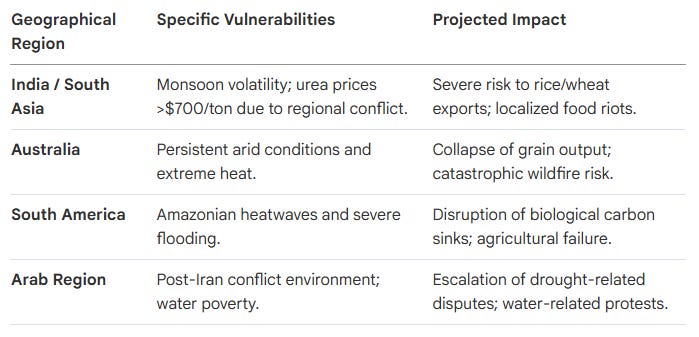
Projected Regional Impacts of 2026 Super El Niño
These tropospheric shocks are deeply coupled with stratospheric systems; however, our ability to regulate these systems is being compromised by a new class of industrial forcing.
Stratospheric Mechanics: The Polar Vortex and ENSO Coupling
The stratospheric polar vortex acts as the primary regulator of global weather stability. Its integrity is a critical proxy for stratospheric strength; a stable vortex contains Arctic air, while a “disturbed” vortex allows for the spillover of extreme weather into mid-latitudes. As an auditor of atmospheric systems, the weakening of this regulator must be viewed as a primary geophysical liability.
Research by Garfinkel & Hartmann identifies that Warm ENSO (WENSO) conditions correlate significantly with a warmer Arctic stratosphere and a weakened polar vortex. Their analysis of the 50-year dataset highlights a critical complexity: during the first half of the record, WENSO and the Easterly Quasi-Biennial Oscillation (EQBO) had a tendency to correlate in time, making these signals difficult to disentangle. However, the current convergence of WENSO and EQBO is known to exacerbate the “disturbed” state of the vortex by modulating the wave-mean flow interaction.
Climatologists utilize temperature anomalies at the 10 mbar level to measure this coupling. When the vortex is weakened, radiative relaxation and heat flux convergence are modulated, allowing planetary waves to penetrate more easily. This creates a dynamical feedback loop where the vortex remains in a diminished state, slowing the global “overturning circulation.” These effects are season-specific, with the most profound Northern Hemisphere impacts occurring during the NDJF period (November–February), while the Southern Hemisphere faces vulnerability during the spring warming (OND period). The introduction of industrial aerosols into this already disturbed system represents a compounding forcing that the stratosphere is ill-equipped to absorb.
Anthropogenic Forcing at Altitude: Rocket Exhaust and Stratospheric Composition
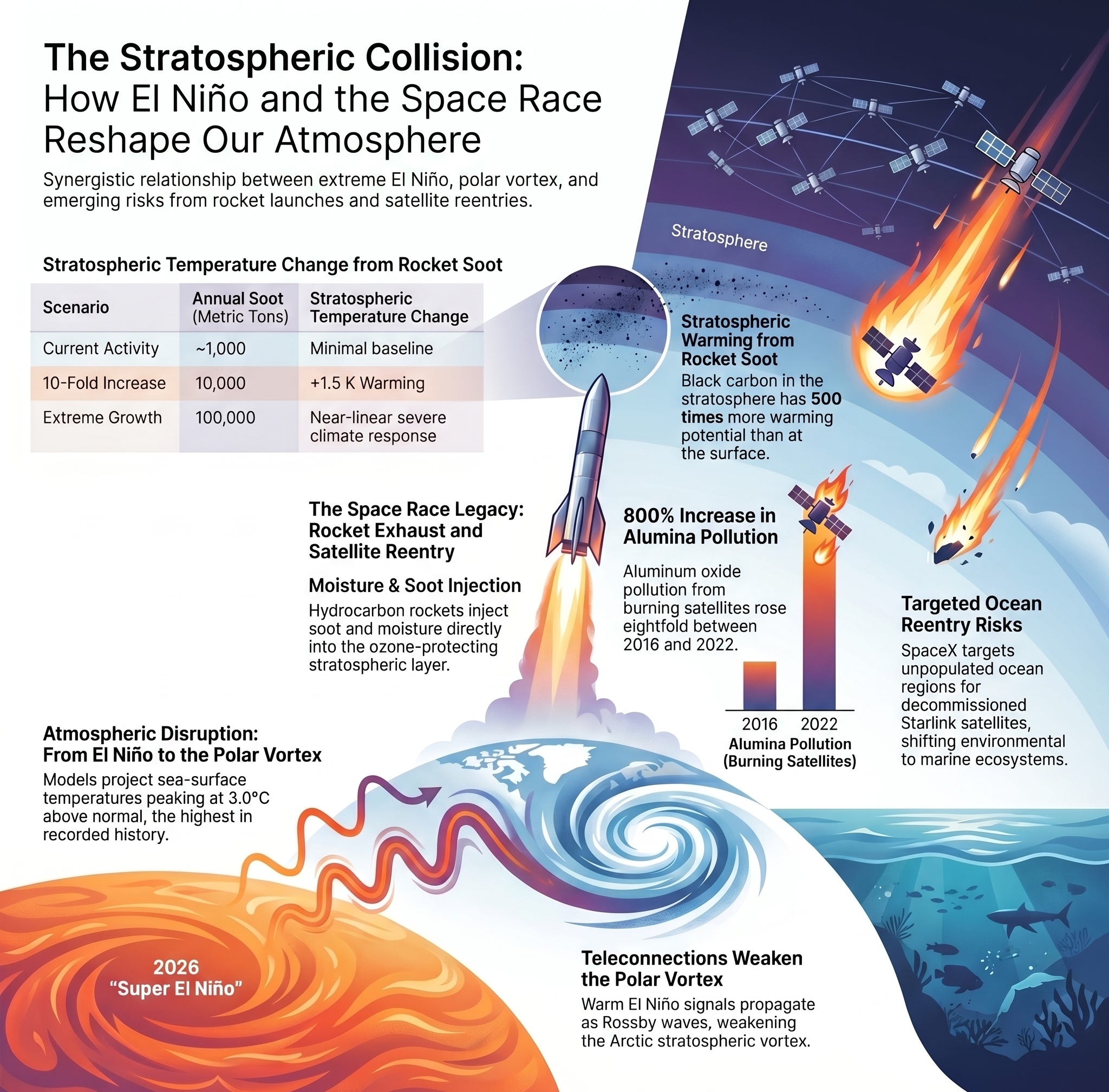
Rockets represent a unique environmental risk as the only human-produced source of aerosol pollution injected directly into the stratosphere, bypassing the natural filters of the troposphere. This direct injection creates a permanent material risk to the ozone layer and global circulation.
Audit Evidence: Stratospheric Impact of Kerosene-Based Injections (Maloney et al.)
Thermal Loading: Black carbon (BC) particles from kerosene engines absorb solar radiation, warming the surrounding stratospheric air by 0.5–2° Celsius.
Circulation Slowing: NOAA Chemical Sciences Laboratory (CSL) data indicates that soot injections weaken the stratospheric overturning circulation by 10%–20%.
Jet Stream Degradation: Modeling shows a 5 m/s slowing of the subtropical jet streams, representing a 3.5% decrease in velocity that alters surface weather patterns.
Spatial Ozone Loss: Audit evidence suggests a pattern of ozone depletion occurring poleward of 30 degrees North (the latitude of Houston), with maximum depletion reaching 4% at the North Pole in June.
This pattern of ozone loss directly coincides with the distribution of black carbon and the associated anthropogenic warming. The stratosphere’s sensitivity to even modest BC injections means that the unregulated growth of the launch industry is actively degrading the Earth’s primary UV shield.
Aerospace Proliferation: The Role of SpaceX and Industry Growth
The aerospace industry is currently in a phase of unquantified externalization. Launch rates have tripled in recent years, with a 10-fold increase projected within two decades. This growth, driven largely by SpaceX’s Starlink deployment and Falcon Heavy launches, utilizes hydrocarbon fuels that saturate the middle atmosphere with soot and moisture.
The “moisture problem” represents a critical synergistic risk. When rockets inject water vapor into the dry stratosphere, they trigger heterogeneous chlorine activation on humidified aerosols. This mechanism is similar to the massive, rapid ozone loss observed following the Hunga Tonga-Hunga Ha’apai eruption. By adding both aerosol surface area (soot) and moisture, the industry is creating an ideal environment for chemical ozone destruction.
NOAA research scenarios for 10,000 to 100,000 metric tons of annual soot emissions reveal a “near linear” climate response. As emissions scale, the stratospheric warming and circulation weakening intensify proportionately. The aerospace industry is not merely utilizing space; it is fundamentally altering the chemistry of the upper atmosphere with a lack of regulatory oversight that would be unthinkable in any other sector.
The Reentry Problem: Exotic Metals and Oceanic Environmental Risk
The environmental impact of aerospace assets is a cradle-to-grave failure. The “destructive reentry” of satellites and upper-stage rockets has become a major, poorly understood source of metallic vapor injection into the middle-to-upper atmosphere.
Findings from the SABRE (Stratospheric Aerosol processes, Budget and Radiative Effects) mission over the Arctic have confirmed a “regime shift” in stratospheric composition. High-altitude sampling shows that 10% of sulfuric acid particles in the stratosphere are now embedded with aluminum and “exotic metal” alloys. Scientists have successfully matched the refractory material ratios of these elements to the specific alloys used in SpaceX/Starlink satellites and rocket components. This confirms that vaporized spacecraft are creating a permanent, human-made layer of metallic smoke.
This metallic vapor eventually settles, compounding the risks to an oceanic environment already in crisis. In 2025, the frequency of marine heatwaves tripled, and the Global Supply Chain Volatility Index hit record levels as the Panama Canal—which manages 3% of global maritime trade—failed due to El Niño-driven droughts. The “downing” of thousands of satellites as part of the Starlink upgrade cycle adds a layer of chemical pollution to marine ecosystems that are already facing simultaneous biological and chemical shocks.
Synthesis of Compounding Risks
The Earth is navigating a “Perfect Storm” where natural climate cycles and industrial irresponsibility converge. The synergy between a record-breaking Super El Niño, a weakened polar vortex, and the unprecedented chemical alteration of the stratosphere by the aerospace industry has created a state of extreme geophysical liability.
The most biting indictment of our current position is the “monitoring crisis.” We are facing the strongest El Niño in history while the very systems needed to track it are being dismantled. The Trump administration cuts to NOAA’s satellite and in-situ observing programs represent a “head-in-the-sand” policy that threatens the Global Climate Observing System. There is a profound and dangerous irony in an era where the aerospace industry is saturating the stratosphere with commercial satellites while the scientific infrastructure required to monitor the resulting environmental fallout is being systematically defunded. We are flying increasingly blind into a regime shift of our own making. Immediate, concerted international action is the only path to preserving the observing systems that provide our final clear view of this unfolding atmospheric catastrophe.


