

The Strategic Weight of Institutional Integrity
The lifecycle of any high-impact organization is defined by its ability to navigate the perilous transition from a “movement” to an “institution.” Movements are fueled by an urgent need to solve a specific societal problem; they are agile, purpose-driven, and fundamentally oriented toward a finish line. However, once a movement achieves institutional status, it acquires assets, hierarchies, and structural incentives that often prioritize the survival of the organization over the resolution of the original mission. Maintaining ethical alignment during this shift requires a constant calibration of the organization’s strategic compass to ensure that the pursuit of social value does not atrophy into a mere pursuit of institutional self-preservation.
The Southern Poverty Law Center (SPLC) serves as a profound case study in this institutional decay. The core thesis of this analysis is that the SPLC, a storied organization once defined by its solution-oriented focus, has become trapped by the very societal fractures it was established to mend. This trajectory—moving from a mission-aligned entity to one that arguably preserves conflict to justify its own existence—has culminated in a catastrophic failure of integrity: a federal indictment involving systemic financial misconduct. To understand how a champion of justice becomes a defendant of the state, we must first examine the organization’s foundational legacy and the “prize” of its initial success.
Foundation and Legacy: The Era of “Done”
To evaluate the performance of a legacy entity, one must establish its “Origin Mission” as a benchmark. For the SPLC, this mission was centered on a clear, high-value social goal: the eradication of hate and extremist movements. In its early decades, the SPLC was a delivery-focused entity. It “done a lot of good,” engaging in the difficult, tangible work of legal advocacy and monitoring that produced measurable results. In this era, the organization operated with a clear finish line in mind—a state of “Done” where specific extremist threats were dismantled and fixed.
This early efficacy earned the organization “The Prize” of institutional maturity. In the framework of organizational theory, the ultimate reward for successful delivery is the creation of a “positive relationship based on trust and reputation.” For the SPLC, years of providing a solution to the “problem” of extremism built an immense reservoir of cultural and financial capital. This reputation became a strategic asset, attracting a massive donor base and establishing the organization as the definitive authority on hate groups. However, as the organization became a “grand old organization,” its survival became its primary business model. The strategic focus shifted from achieving “Done” to a modern survival strategy that relies on the perpetual maintenance of the problem it was designed to solve.
The Modern Pivot: Labels as a Strategic Tool
One of the most significant strategic risks for a legacy institution is “mission creep,” where the organization weaponizes its legacy status to serve ideological or survival ends. Critics and analysts suggest the SPLC has undergone such a pivot, transitioning from an objective monitor of extremism to a “tool of the left.” In this modern iteration, the organization’s primary output is no longer the resolution of hate, but the strategic application of derogatory labels like “racist” or “white supremacist.”
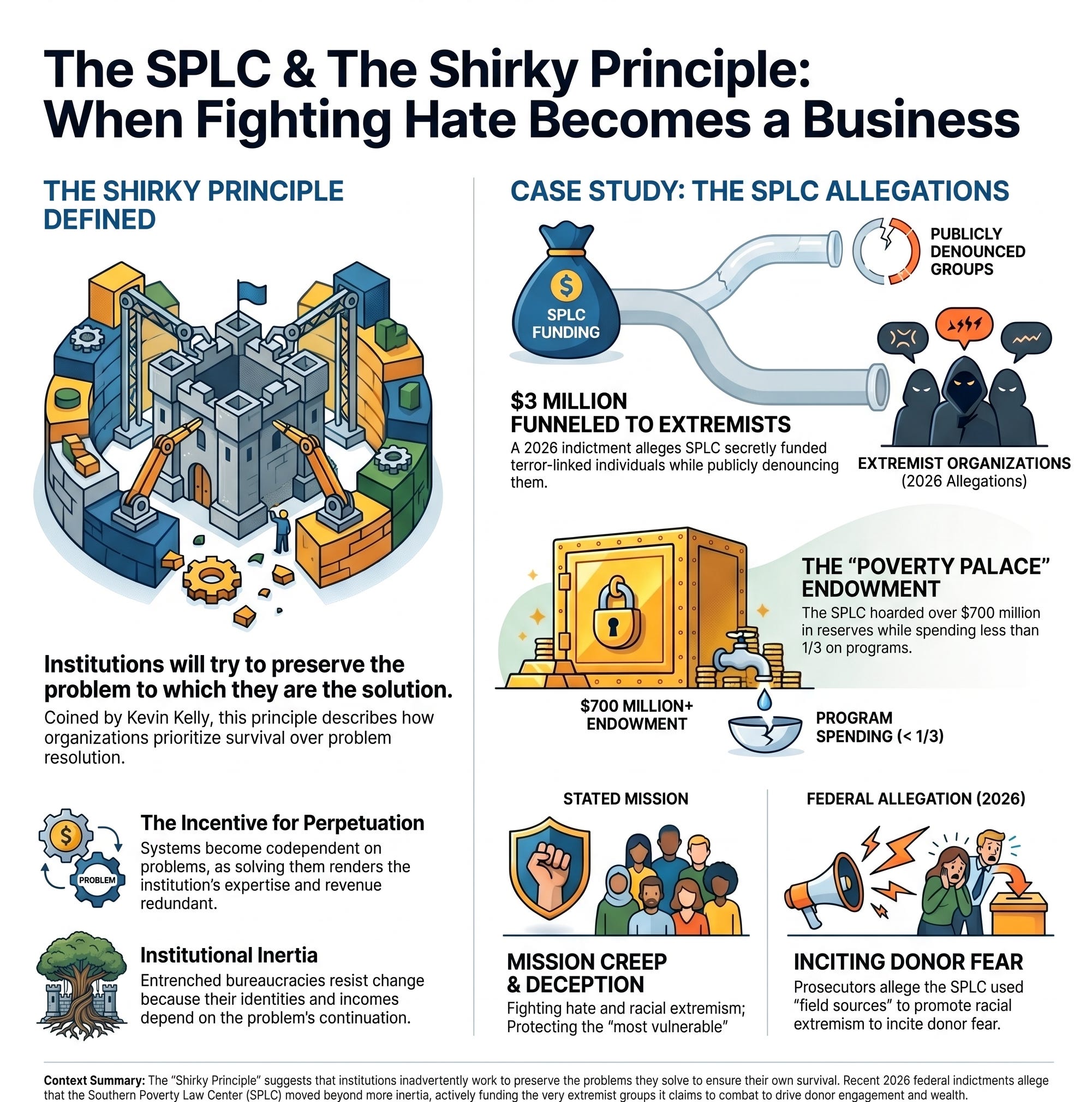
From an institutional strategist’s perspective, this labeling is not merely an ideological shift; it is a structural necessity for survival. Applying the Shirky Principle—the idea that “institutions will try to preserve the problem to which they are the solution”—we see that the SPLC has become an “institutionalized human” entity. As Tim Denning notes, such institutions “resolve ambiguity in favor of continuity.” Because the SPLC’s massive funding and cultural relevance are predicated on the presence of extremism, the actual eradication of that threat would be “unprofitable” and existential.
By broadening definitions and labeling new groups as extremists, the organization ensures its own continuity. The “So What?” layer here is devastating: social data has been transformed into a political weapon. As we have seen in the digital era, “software [and social data] is politics now.” When an institution uses its legacy authority to “hurt people” through labeling rather than solving societal issues, it stops being a solution and starts being a source of the very complexity and conflict it claims to oppose.
The Federal Indictment: Allegations of Systemic Failure
Legal accountability serves as the ultimate “crisis” that forces institutional reflection. For the SPLC, this crisis reached a zenith with a Federal Grand Jury indictment. While the full narrative of leadership involvement remains for the courts to determine, the nature of the charges themselves points to a fundamental departure from a mission of social justice.
According to the U.S. Department of Justice, the Southern Poverty Law Center faces specific, high-stakes criminal charges:
Wire Fraud: The alleged use of electronic communications to orchestrate fraudulent schemes.
False Statements: The deliberate provision of misleading information.
Conspiracy to Commit Money Laundering: Strategic efforts to conceal the origins of funds.
The strategic implication of these charges is profound. Fraud and money laundering are not “mission-related outcomes”; they are symptoms of an institution that has become a self-serving machine. When an organization founded on ethics is indicted for financial conspiracy, it suggests the “business” of the institution—its capital and its survival—has completely eclipsed the original “movement” that gave it life.
The Shirky Principle and Institutional Preservation
The decay of the SPLC is a classic manifestation of the Shirky Principle: “Institutions will try to preserve the problem to which they are the solution.” In the mechanics of institutional survival, bureaucracies instinctively protect the status quo of their own business model. For the SPLC, the status quo is a world filled with visible, growing hate groups.
This creates a perverse incentive structure. To maintain growth, the institution must “resolve ambiguity in favor of continuity”—meaning it must find more hate, more frequently, in more places. By expanding the parameters of what constitutes a “hate group,” the SPLC “trapped themselves” in a cycle where they require the problem of extremism to remain prevalent to justify their existence.
This mirrors the “Millionaires Club” risk seen in failing government IT megaprojects: a scenario where a small circle of stakeholders benefits from a “crumbling structure” that is held together “long past its natural life.” While the SPLC may not be a government contractor, the pathology is identical: fairness and societal progress become “unprofitable” compared to the maintenance of a high-stakes, high-revenue “burning platform.”
The “Snail” of Institutional Decay: Comparative Examples
Institutional decay is rarely a sudden collapse; it is the “Giant Snail” of technological and social change. As internet pioneer Tom Coates famously noted, organizations often cry out in fear when the snail finally reaches them, ignoring that “the snail’s been moving closer for the last twenty years... and they just weren’t paying attention.” The SPLC spent decades ignoring the “snail” of its own ethical and mission-driven decay until the federal government finally intervened.
This pattern is not unique to social advocacy. It is a recurring feature of modern “Industrial Complexes” where institutions choose survival over resolution:
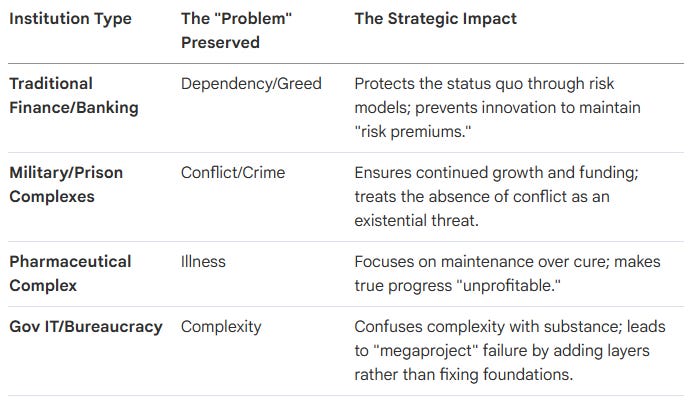
For these entities, “survival is apparently optional.” Much like Kodak—which invented digital photography in 1975 only to “stuff the invention in a cupboard” to protect its film business—the SPLC would rather cling to a broken, labeling-based model than risk the disruption of actually succeeding in its mission.
Breaking the Cycle: Solutions for Institutional Recovery
Breaking the Shirky Trap requires a commitment to “fixing it and letting it stay fixed.” For an organization as entrenched as the SPLC, recovery necessitates a radical departure from current bureaucratic incentives. As the framework of Digital Transformation at Scale suggests, “getting this right isn’t complicated; it’s just hard,” primarily because it requires fighting the “gravitational pull” of the institution.
To recover, an institution must adopt the following Design Principles:
Prioritize Delivery over Strategy: Focus on tangible results—such as measurable reductions in extremist activity—rather than generating elegant “hate maps” and strategy papers that merely justify the organization’s fundraising.
Radical Transparency: “Make things open.” Operating in the open invites the scrutiny necessary to prevent the development of a self-serving “Millionaires Club” mentality among leadership.
User-Centric Mission: Start with the actual needs of the citizens and victims of hate, rather than the preservation of the institution’s own power and political influence.
Accepting Obsolescence: Mature organizations must have the courage to acknowledge when a mission—or a specific tactic—is “Done.” They must pivot to authentic new challenges rather than manufacturing “complexity” to stay relevant.
Ultimately, the SPLC’s survival depends on whether its leadership can find the “digital competence, curiosity, and confidence” to dismantle their own trap. Without a willingness to “cannibalize their own business” to progress, even the most legendary institutions are doomed to be run over by the snail of their own making.


