

The Whistleblower’s Mandate and Context
The May 2026 hearing before the Senate Homeland Security and Governmental Affairs Committee serves as a critical juncture in evaluating the erosion of analytical tradecraft within the United States intelligence community (IC). For the maintenance of national security and the preservation of public trust, it is a strategic imperative that intelligence remains an objective, evidence-based discipline, compartmentalized from political pressures and external policy agendas. When senior administrative layers subvert the findings of subject matter experts (SMEs) to favor a predetermined narrative, the resulting politicized intelligence compromises the foundation of sovereign decision-making.
The gravity of the current inquiry is substantiated by the professional profile of James E. Erdman III, whose career reflects high-level access and recognized expertise:
Senior CIA Operations Officer: A veteran intelligence officer with decades of experience in national security and clandestine operations.
Military Background: Served with the 2nd Battalion, 75th Ranger Regiment.
Leadership of the Directors’ Initiatives Group (DIG): Led investigations into COVID-19 origins, anomalous health incidents (AHI), and unidentified anomalous phenomena (UAP) within the Office of the Director of National Intelligence (ODNI) from March 2025 to April 2026.
Grassroots Advocacy: Co-founder of “Feds For Freedom,” an organization established to address government mandates.
Educational Credentials: Holds a Bachelor of Science in Biology (Minor in Chemistry) from Western Oregon University.
Professional Commendations: Recipient of the CIA Intelligence Medal of Merit and the Director of National Intelligence National Intelligence Award.
The testimony of a decorated officer with these specific credentials represents a significant paradigm shift in the investigative landscape. Unlike previous anonymous assertions, Erdman’s sworn testimony provides a transparent, verifiable account of the IC’s internal procedural deviations. His dual background in biological science and operational leadership allows for a granular critique of how intelligence tradecraft was allegedly subverted, moving the committee’s inquiry from general suspicion toward a documented examination of structural interference.
Systematic Suppression and Alteration of Intelligence Reports
The intelligence community is predicated on the rigorous application of objective tradecraft, where findings are driven by SMEs rather than administrative preference. The strategic danger of “top-down” analytical interference is that it transforms the IC into a narrative-reinforcement mechanism, blinding policymakers to legitimate biological threats. Testimony suggests that CIA senior leadership systematically suppressed corroborating evidence of a research-related origin to maintain a zoonotic consensus.
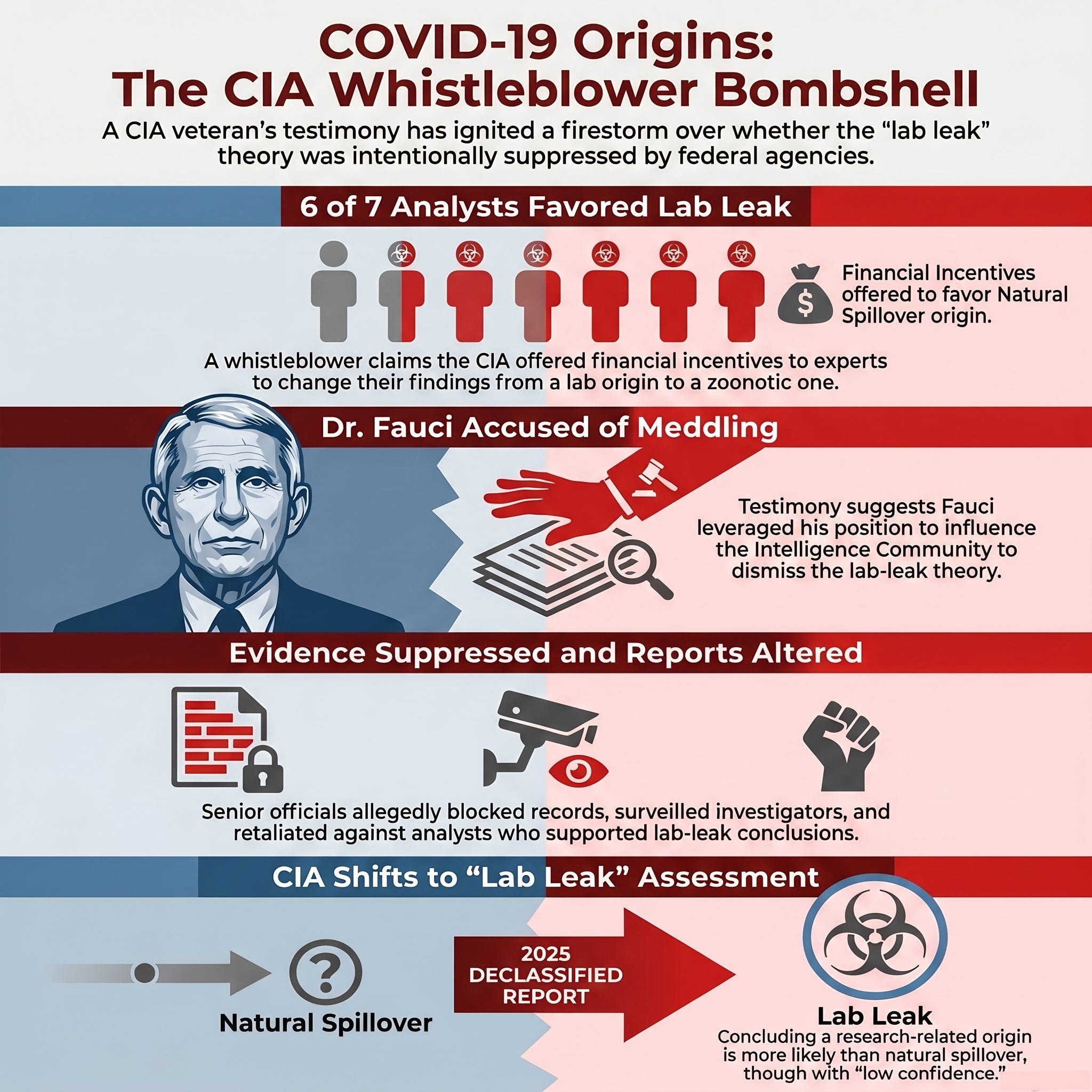
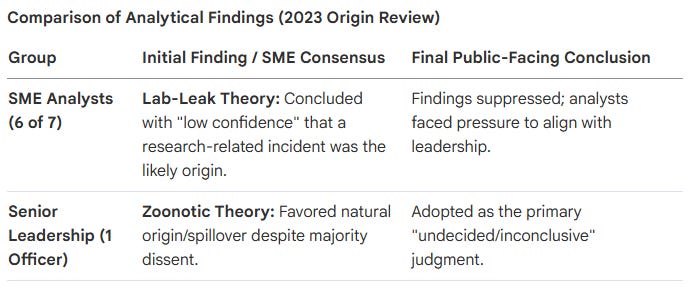
Evidence presented by the whistleblower details a pattern of “middle of the night anonymous rewrites,” wherein senior officials unilaterally altered analytical products. These were not merely stylistic edits but fundamental reversals of intelligence judgments. In the 2023 review, a seven-member team reached a conclusion that was subsequently overruled by a single senior administrative officer.
The “So What?” layer of this analytical transformation involves the direct impact on domestic and global public health policy. By suppressing the lab-leak hypothesis, the IC provided a sanitized intelligence environment that facilitated emergency use authorizations (EUAs) for mRNA products. Whistleblower testimony argues that public health policy, including mandates, would have faced a significantly different scrutiny threshold had the American public been informed that the virus likely served as the foundation for gain-of-function research in China.
External Influence and the Fauci-BSEG Nexus
The integrity of the IC is jeopardized when external actors with vested interests achieve “regulatory capture” over the analytical process. This “analytical meddling” creates profound counter-intelligence risks, as it allows individuals outside the traditional oversight framework to curate the evidence presented to the President.
Whistleblower claims identify Dr. Anthony Fauci as having an intentional role in leveraging his position to influence the CIA’s origins review. Allegations suggest Fauci ensured the IC consulted with a “conflicted list” of curated experts, including authors of the “Proximal Origin” paper and associates whose research was funded by his own agencies.
This influence was primarily channeled through the Biological Sciences Experts Group (BSEG), an ODNI advisory body. The BSEG functioned within an “oversight-resistant ecosystem” where scientists were essentially “grading their own homework”:
Direct Conflicts: BSEG members conducted government-funded research while simultaneously consulting for the IC on biodefense.
Financial Confluences: Members received significant funding from NIDA and other public health agencies for the very coronavirus studies they were tasked with analyzing.
Policy Redefinition: Several BSEG scientists reportedly assisted Dr. Fauci in 2015 in rewriting the definition of “gain-of-function” research to circumvent funding pauses on high-risk pathogens.
Pre-Positioning Narratives: In a notable confluence of interest, BSEG members and senior IC officials—including then-DNI Avril Haines—participated in “Event 201” in 2019, a pandemic exercise that mirrored the subsequent global outbreak with clinical precision.
This web of relationships operated without holistic monitoring for over two decades, allowing biodefense analysis to be influenced by the very actors responsible for the research under investigation.
4. Allegations of Coercion, Surveillance, and Retaliation
Whistleblower protections are a cornerstone of national security, ensuring that expert dissent reaches Congress. However, testimony indicates the CIA utilized intelligence assets and administrative authority to engage in domestic surveillance and retaliation against those who challenged the zoonotic narrative.
In 2023, the agency allegedly offered “significant monetary incentives” to the six analysts who had favored the lab-leak theory. The whistleblower clarifies that while these “bribes” were offered to induce a change in analytical position, the analysts maintained their integrity, took administrative measures to address the breach of tradecraft, and subsequently faced severe reprisal:
Administrative Retaliation: The firing of whistleblowers and specialists who refused to sign off on the “middle of the night” report rewrites.
Domestic Surveillance: Allegations of illegal surveillance conducted against White House and Trump administration investigators who were probing the origins of the virus.
Transparency Obstruction: The systematic suppression of records and the refusal to comply with lawful congressional oversight requests regarding COVID-19.
These tactics severely compromise analytic integrity. By punishing SMEs for adhering to evidence, the agency discourages future dissent and ensures that finished intelligence reflects administrative desires rather than ground-truth realities.
Evolution of the CIA’s Formal Assessment (2021–2025)
The strategic declassification of intelligence is a vital tool for correcting historical narratives and providing transparency to the taxpayer. Between 2021 and 2025, the IC’s public posture transitioned from active dismissal of a laboratory origin to a reluctant acknowledgment of its plausibility.
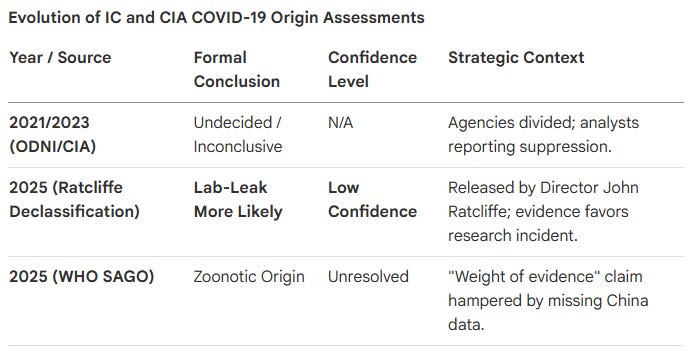
The “low confidence” status cited in the Ratcliffe declassification is primarily attributed to intelligence gaps caused by the Chinese government’s refusal to cooperate. This includes the withholding of early patient sequences from Wuhan, laboratory biosafety logs, and wildlife supply-chain documentation.
As noted by Representative August Pfluger, there is a profound irony in the eventual declassification: the CIA’s final analysis favored the same theory that the agency—and the broader government—had previously dismissed as a “conspiracy theory.” This confirms a significant disparity between internal intelligence data and the public-facing narrative.
Geopolitical Implications and Policy Recommendations
The failure to maintain analytical objectivity has deeply polarized the diplomatic landscape. While Senator Tom Cotton has called for accountability from China for “unleashing a plague,” the Chinese Foreign Ministry, through spokesperson Mao Ning, continues to label the lab-leak theory a “lie concocted by anti-China forces.” This deadlock is a direct result of the IC’s initial inability to produce a unified, tradecraft-backed assessment.
To restore the integrity of the national security apparatus, the following reforms are required:
Institutional Separation of Public Health and Biodefense: The United States must establish a firewall to ensure that public health objectives do not influence the IC’s biodefense assessments.
Eradication of Oversight-Resistant Ecosystems: Implement mandatory, holistic monitoring of funding and academic confluences for all “life science” actors consulting for the intelligence community.
Mandatory Tradecraft Protections: Codify legal requirements that prohibit senior leadership from anonymously altering SME findings, ensuring that dissenting views are preserved in the final intelligence product.
Transparency is a national security necessity. To prevent future pandemics and ensure that the IC remains a science-based rather than a narrative-based discipline, the U.S. government must prioritize the accuracy of its intelligence over the convenience of its politics.


