

Current Developments: The 2026 Virginia Legislative Shift
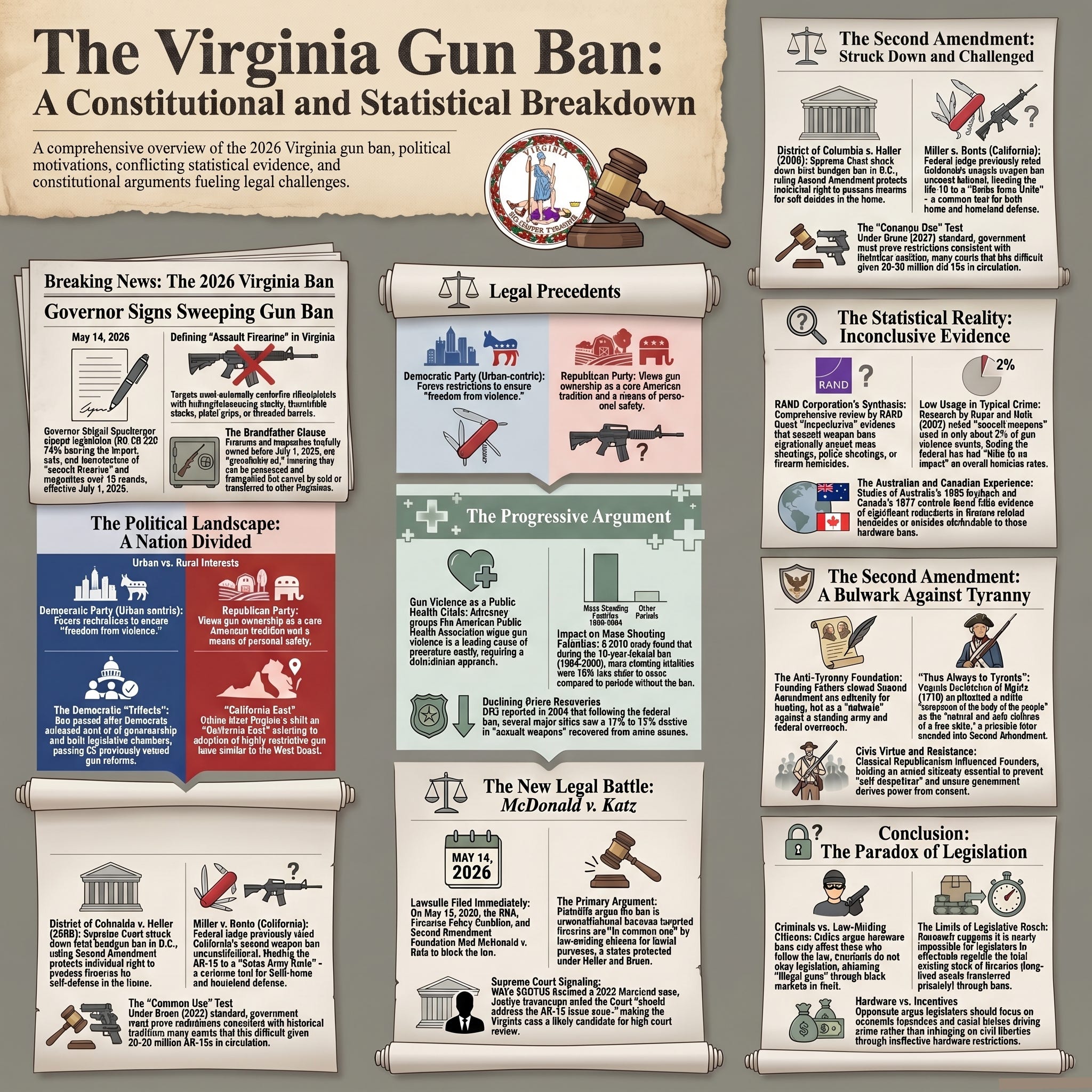
On May 14, 2026, Governor Abigail Spanberger formally signed House Bill 217 (HB217) and Senate Bill 749 (SB749), precipitating a definitive fracture in the Commonwealth’s legal landscape. This action signals Virginia’s transition to “California East” status, fundamentally altering a jurisdiction once defined by its adherence to traditional Second Amendment protections. By opting for a direct confrontation with the federal judiciary’s current interpretative standards, the administration has elevated Virginia to the center of a high-stakes constitutional crisis. The Governor’s choice to broaden definitions in the face of explicit federal warnings constitutes a deliberate jurisdictional challenge that invites immediate textualist scrutiny.
Legislative Deconstruction of HB217/SB749 The new statutes implement a comprehensive prohibition on “assault firearms” and specific ammunition feeding devices, effective July 1, 2026. The core provisions include:
Definition of “Assault Firearm”: The law establishes a tiered cosmetic feature test. Long guns are classified as assault firearms if they are semi-automatic, centerfire, and possess one prohibited feature (e.g., folding/telescoping stocks, thumbhole stocks, or second handgrips). Handguns are subject to the ban if they possess two such features.
Magazine Capacity Restrictions: A total ban on the import, sale, or transfer of ammunition feeding devices capable of holding more than 15 rounds.
Criminal Penalties: Violations are classified as Class 1 misdemeanors. Notably, a conviction carries a mandatory three-year prohibition on the purchase, possession, or transportation of any firearm.
Serialization Mandate: Under the related SB 323, all unfinished frames, receivers, and “ghost guns” must be serialized. Possession of unserialized firearms becomes a criminal offense on July 1, 2027.
Executive Action and Jurisdictional Friction Governor Spanberger’s decision to “toughen” the legislation through substitutes—expanding the scope of prohibited features despite a formal warning from the U.S. Department of Justice (DOJ) Civil Rights Division—illustrates a calculated shift toward progressive maximalism. While her office frames these amendments as providing “clarity,” critics and federal observers characterize the move as a “bait and switch” that departs from her moderate campaign rhetoric. This legislative overreach serves as the catalyst for a broader national realignment, where state-level mandates are increasingly used as ideological projectiles against a conservative-leaning federal judiciary.
The Sociopolitical Dichotomy of Gun Control in the U.S.
The Virginia legislative shift is the inevitable result of a historical realignment that has transformed firearm ownership into a primary marker of cultural and geographic identity. The Second Amendment no longer functions as a bipartisan consensus on individual liberty but rather as a non-negotiable divide between two distinct visions of the American social contract.
Urban vs. Rural Polarization Firearm policy in the modern era is dictated by a stark “Urban vs. Rural” dichotomy. The Democratic “Urban Party” prioritizes a “freedom from violence” framework, viewing firearms as collective public health risks that necessitate state-managed mitigation. Conversely, the Republican “Rural/Libertarian” constituency views gun ownership through the lens of “freedom from government restriction.” In these communities, the firearm remains a tool of self-reliance and a symbol of personal sovereignty.
The Identity Politics of the Second Amendment Modern Republicanism has coalesced around gun rights as a foundational pillar, synthesizing libertarianism, pro-military sentiment, and the “moral majority” into a singular defense of the Second Amendment. For this coalition, any restriction on “common use” arms is viewed as an assault on the American identity itself. This polarized environment ensures that legislative victories like those in Virginia are not seen as settled policy but as opening volleys in a judicial counter-offensive.
Judicial Volatility: Precedents of Overturned Legislation
Virginia’s new statutes face a precarious future due to the “Text, History, and Tradition” standard established by the Supreme Court in NYSRPA v. Bruen. Under this standard, any regulation of conduct falling within the Second Amendment’s plain text must have a historical analog from the founding era. State-level bans frequently fail this test because they target arms that are in “common use” for lawful purposes—a standard articulated in Heller.
Case Study: California’s Overturned Ban A bellwether for Virginia’s impending legal battle is the 2026 federal court decision out of San Diego that overturned California’s 32-year-old assault weapons ban. The presiding judge ruled that the state’s definitions of military-style rifles “unlawfully deprive law-abiding Californians of weapons commonly allowed in most other states.” This ruling underscores the fragility of “assault weapon” definitions when subjected to federal judicial scrutiny.
The “Common Use” Argument The Virginia Citizens Defense League (VCDL) has centered its legal strategy on the sheer volume of protected firearms currently in circulation, arguing that the legislative definitions are untethered from constitutional reality.
“The guns and magazines targeted by this bill are among the most common guns and magazines in the United States... There are conservatively estimated to be over 20 million AR-15s and millions of magazines that hold more than 15 rounds in civilian hands.” — Virginia Citizens Defense League (VCDL)
The Progressive Paradigm: Rationalizing Restriction
Progressive architects of the Virginia ban justify these restrictions through a public health paradigm, shifting the focus from individual rights to collective risks. This philosophical framework posits that the state has a moral and utilitarian obligation to intervene in what it characterizes as an “epidemic” of gun violence.
The “Freedom From Fear” Framework Invoking FDR’s “Four Freedoms,” proponents argue that true liberty is impossible without “freedom from fear.” In the wake of mass shootings, the Governor’s office maintains that the presence of high-capacity magazines and semi-automatic rifles creates a climate of communal terror that overrides individual property rights.
Common-Sense Safety vs. Absolute Rights State leaders argue that gun safety laws correlate with lower firearm injury and death rates, framing the legislation as a “common-sense” intervention. However, this philosophical appeal to “freedom from fear” must ultimately be weighed against the empirical data regarding actual policy efficacy and the constitutional mandate that protects the instrumentation of self-defense.
5. The Empirical Gap: Analyzing Policy Efficacy vs. Statistical Reality
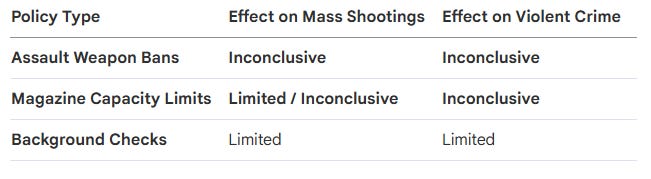
The strategic importance of unbiased data is paramount in moving past political rhetoric. High-level synthesis of research from the RAND Corporation and other academic repositories reveals a significant paucity of evidence linking restrictive bans to reduced crime rates.
Synthesis of Research Evidence (RAND 5th Edition) Per the RAND “Science of Gun Policy” (updated February 2026), the evidence for the effectiveness of the very policies Virginia has enacted remains notably weak.
International and Historical Failures
Australia (Lee & Suardi): A structural break test of the 1996-1997 Australian National Firearms Agreement and buyback program found “little evidence to suggest that it had any significant effects on firearm homicides and suicides.” The study concluded that high expenditure did not translate into tangible reductions in death.
United States (Koper and Roth): An evaluation of the 1994 U.S. Federal Assault Weapons Ban found “no discernible reduction in the lethality and injuriousness of gun violence” during its decade of implementation.
The Geographic Export of Crime Guns Sales bans fail to address the primary pipeline of “crime guns”: theft. Data from the Harvard DASH repository reveals that the South—which accounts for 43% of gun owners but two-thirds of all gun thefts—acts as a massive “exporter” of crime guns to the Northeast. Geographic proximity and unsafe storage are higher risk factors for illegal acquisition than the legal sale of a semi-automatic rifle.
The Second Amendment: Philosophical Roots and the Anti-Tyranny Mandate
The resistance to Virginia’s ban is rooted in Enlightenment-era “English Republicanism.” The Founders viewed a citizen’s right to bear arms not as a privilege for sport, but as a structural check on centralized power.
The Intellectual Lineage of the Citizen Militia Thinkers such as James Harrington (The Commonwealth of Oceana), Algernon Sidney, and John Trenchard argued that property ownership was a prerequisite for citizenship because it provided the “stake in the country” necessary for a virtuous militia. Harrington specifically linked the “bearing of arms” to the defense of property and liberty, a concept that fundamentally informs the Second Amendment.
The “Sword by the Side” Doctrine This tradition is defined by a three-fold Republican belief:
Skepticism of Standing Armies: Professional militaries were viewed as rapacious tools of despots loyal to a paycheck rather than the people.
Commitment to the Citizen Militia: The belief that “a well-regulated militia, composed of the body of the people,” is the only safe defense of a free state.
The Deterrence Principle: The “Sword by the Side” doctrine, famously captured in Cato’s Letters, posits: “A Man that hath a Sword by his side, shall have least occasion to make use of it.”
The Amendment exists as a deterrent against a government that might otherwise ignore the “purse” of an unarmed populace. It is an anti-tyranny mandate that transcends simple self-defense.
The Counter-Offensive: Impending Litigation and Law Enforcement Defiance
The signing of the Virginia ban has triggered an immediate and coordinated counter-offensive across the legal and executive branches.
McDonald v. Katz The Firearms Policy Coalition (FPC), joined by the NRA and the Second Amendment Foundation, has filed McDonald v. Katz in the U.S. District Court for the Eastern District of Virginia. The suit argues that HB217/SB749 criminalizes constitutionally protected conduct by targeting arms in common use.
Executive and Inter-Branch Friction U.S. Assistant Attorney General Harmeet Dhillon provided “formal notice” to Governor Spanberger that the DOJ Civil Rights Division would commence litigation, noting that the AR-15 is a constitutionally protected arm. Virginia Attorney General Jay Jones responded by calling the notice a “threat” and a “distortion” of the Office of Civil Rights, illustrating the profound friction between state and federal executive branches.
Local Enforcement Defiance Sheriffs across Central Virginia, including Sheriff Jimmy Ayers (Amherst) and Sheriff Wayne Davis (Henry), have signaled they will not enforce laws they deem unconstitutional. They argue their primary duty is to the Constitution, not to legislative overreach that infringes upon the rights of law-abiding citizens.
Synthesis: The Limits of Legislative Deterrence
The Virginia gun ban exemplifies the inherent limits of legislative deterrence. By targeting the instrumentation of the law-abiding, the state fails to impact the behavior of those with criminal intent, who operate entirely outside the regulatory framework.
The Irony of the Market Response The most immediate effect of the ban has been a massive “Gun-Buying Boom.” In March 2026, Virginia saw 79,846 background checks, one of the highest monthly totals in history. Sales at some retailers have increased 4 to 10 times their normal volume. As pro-gun advocates have noted, the Democrats have become the “beautiful salespeople to the arms industry,” inadvertently ensuring that the firearms they seek to ban are more prevalent in the Commonwealth than ever before.
Final Summary The constitutional friction in Virginia highlights a fundamental reality: legislative efforts that ignore “Text, History, and Tradition” while failing to address the root causes of violence are destined for judicial failure. Until policy shifts from the instrumentation of the citizen to the intent of the criminal, the modern political divide will only deepen, leaving the Commonwealth in a state of perpetual litigation and civic unrest.


