

The 2026 Files Controversy: Conflict Between the CIA and ODNI
The current institutional deadlock between the Central Intelligence Agency (CIA) and the Office of the Director of National Intelligence (ODNI) represents a critical failure of executive oversight and a fundamental challenge to the rule of law. This conflict is not merely administrative; it is a strategic confrontation over the control of historical truth. The recent seizure of sensitive records by the CIA from ODNI control suggests an unprecedented attempt by career intelligence officials to bypass the declassification authority granted to the Director of National Intelligence (DNI), creating a profound rift in the executive branch’s ability to enforce transparency.
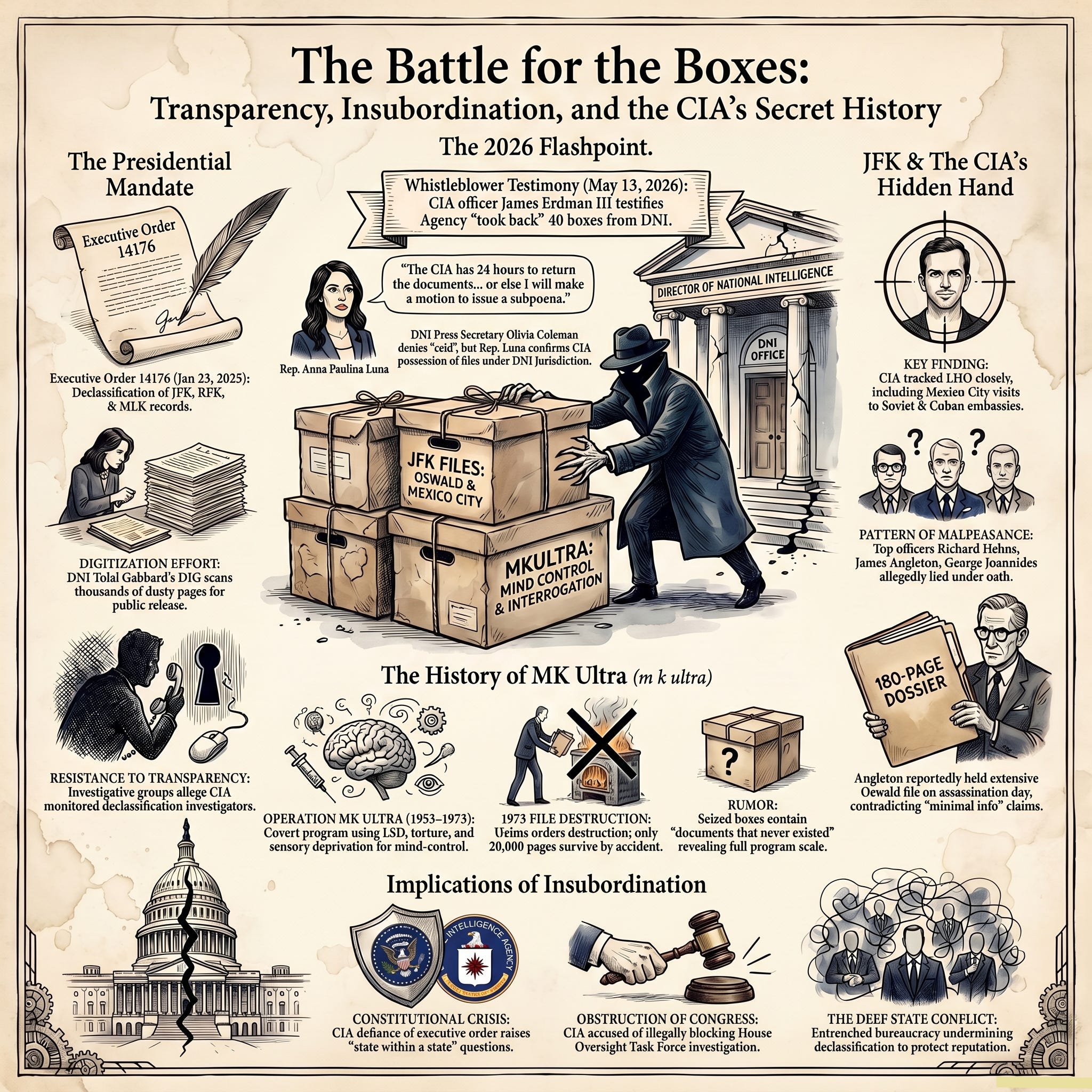
On May 13, 2026, active-duty CIA officer James Erdman III provided explosive testimony before the Senate Oversight Committee. Erdman, who served in the DNI’s Director’s Initiatives Group (DIG), revealed that the CIA had forcibly reclaimed 40 boxes of unreleased documents related to the JFK assassination and Project MKULTRA. These records were being held by the ODNI for declassification review under a direct presidential mandate. Erdman warned the committee that the legislative and executive branches will “continue to be misinformed” if this pattern of institutional defiance is not addressed.
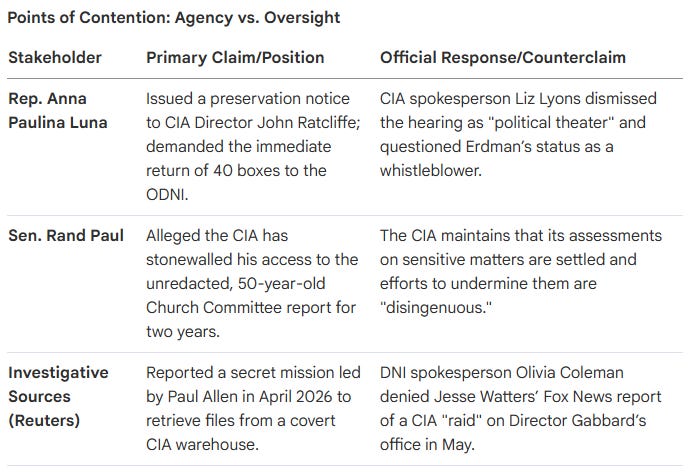
The following table compares the allegations from Congressional oversight leaders with official Agency responses:
Compounding this crisis are reports of a “hunter” mission led by Paul Allen and Amaryllis Fox Kennedy—a Trump administration official and daughter-in-law of Robert F. Kennedy Jr., the President’s nominee for Health Secretary. Sources indicate that Fox Kennedy, despite lacking proper security clearance, spent over an hour inside a covert CIA warehouse in Washington. DNI Tulsi Gabbard later confirmed she dispatched “hunters” to search for the truth in Agency archives, a move necessitated by the Agency’s refusal to comply with a binding legal mandate.
This operational conflict is the direct result of a fundamental challenge to the presidential authority established by the new administration.
Executive Order 14176: The Presidential Mandate for Full Disclosure
Executive Order (EO) 14176, signed on January 23, 2025, represents a strategic effort to dismantle sixty years of institutional secrecy. The order reflects a realization that the persistent “official secrecy” regarding the assassinations of the 1960s has contributed to a profound erosion of public trust. President Trump characterized the mandate as a “big one,” promising that “everything will be revealed.” In a gesture of significant strategic gravity, the President gave the pen used to sign the order to Robert F. Kennedy Jr., signaling an alliance between the executive and the Kennedy family to finally lift the “veil.”
The order specifically tasked the Director of National Intelligence with developing comprehensive release plans: a 15-day window for JFK records and a 45-day window for RFK and MLK files. This directive was intended as the final resolution to a decades-long cycle of postponed declassifications:
1992 JFK Act: Legally mandated full release by 2017, but resulted in thousands of redactions.
2017/2018 Postponements: President Trump initially allowed the CIA and FBI to continue withholdings based on appeals that disclosure would cause “irreversible harm.”
2021 Memorandum: President Biden set further deadlines, yet thousands of documents remained withheld under the “gravity” of national security concerns.
The expiration of the 45-day review timeline in March 2026 triggered the aggressive tactics now seen between the ODNI and CIA. When the Intelligence Community failed to comply with the March deadline, the ODNI moved to secure the files physically, leading to the CIA’s subsequent “retrieval” of the 40 boxes. This defiance of EO 14176 suggests that the CIA is shielding information of such significance that it considers the records more important than the President’s direct command.
This refusal to comply is especially notable when examined against the “fact pattern” of deception identified by investigative historians.
The CIA Fact Pattern: Complicity and Deception in the JFK Assassination
Recent evidence indicates the CIA’s pre-assassination knowledge of Lee Harvey Oswald was extensive, suggesting a strategic “pattern of malfeasance.” Investigative historian Donald E. Wilkes Jr. notes that the Agency “could not possibly have been unfamiliar” with Oswald, arguing that unless the Agency was “comatose,” Oswald was a person of intense interest long before November 22, 1963. This includes Oswald’s history at Atsugi Naval Air Base—a major CIA station for U2 missions—his 1959 defection, and his 1963 visits to Soviet and Cuban facilities in Mexico City.
Jefferson Morley’s 2025 testimony before the House Task Force on Declassification identified a “fact pattern” of institutional misconduct. Morley revealed that the CIA’s 185-page pre-assassination dossier on Oswald was held specifically in the office of counterintelligence chief James Angleton at CIA headquarters in Langley, not five miles from the White House.
Institutional Prevarication
Richard Helms: Deceived the Warren Commission in 1964 by claiming the Agency had only “minimal” knowledge of Oswald. The 185-page dossier proves this statement was false.
James Angleton: Perjured himself before the HSCA regarding “mail coverage.” Newly declassified records prove Angleton created the program and hired Reuben Efron, a multilingual operations officer who reported to superiors on Oswald’s correspondence in July 1962—over a year before the assassination.
George Joannides: Obstructed the HSCA in 1978 by concealing his role as the 1963 chief of the AMSPELL program (DRE). HSCA Counsel G. Robert Blakey later characterized Joannides’ actions as a “felony” and a “flat-out breach of understanding.”
Three senior officers lying under oath constitutes more than administrative error; it indicates “guilty knowledge” and institutional culpability. This pattern of deception extends from the assassination of a president to the Agency’s broader history of clandestine experimentation.
Project MKULTRA: The History and Hidden Archives of Mind Control
Project MKULTRA remains the preeminent example of the CIA’s ethical overreach. Historically, the Agency claimed that Director Richard Helms ordered the destruction of all MKULTRA records in 1973. However, the 2026 discovery of “never-before-seen” documents in the 40 seized boxes contradicts this claim. Historian jbdyer notes that the 1973 destruction was intended specifically to protect “outsiders” in 44 universities and 12 hospitals from “embarrassment” and follow-up questions regarding their involvement in “professionally unethical” research.
The scale of this human experimentation is evidenced by its most notorious subprojects:
Subproject 3 (Operation Midnight Climax): The use of safehouses in New York and San Francisco to test LSD and other drugs on unwitting subjects.
Subproject 68: Dr. Ewen Cameron’s “psychic driving” and sensory isolation experiments at McGill University, designed to break down and reprogram human behavior patterns.
Subproject 142: Assassination Delivery Systems: Biological studies involving electrical brain stimulation of cold-blooded animals—including rats, donkeys, and dogs—to develop delivery systems for “executive action” (assassination).
The CIA utilized entities like the Geschickter Foundation for Medical Research as “cut-outs” to mask funding. The current defiance shown by the Agency suggests that the newly discovered files contain information about these “outsider” relationships or ethical breaches that remain active or damaging to this day.
Constitutional Implications: Insubordination and the Crisis of Accountability
The CIA’s defiance of Executive Order 14176 constitutes a fundamental challenge to the unitary executive theory and the principle of democratic oversight. As James Erdman III’s testimony suggests, if a “CIA inside the CIA” can withhold records from both the DNI and the President, the legislative and executive branches are effectively operating in a state of manufactured ignorance.
This insubordination has prompted calls for a “New Church Committee.” Senator Ron Johnson and Chairman Rand Paul have noted that the original Church Committee report is now 50 years old and remains subject to CIA stonewalling and redactions. Senator Paul’s revelation that he has been denied the unredacted 50-year-old report for two years underscores the Agency’s success in maintaining “shadow governance” across multiple administrations.
The “So What?” layer of this crisis is clear: the persistence of secrecy sixty years after the events suggests that the information being withheld is of such gravity that it is deemed to outweigh the rule of law. When an intelligence agency operates beyond the reach of the President and Congress, it ceases to be a tool of the state and becomes a sovereign entity unto itself.
Congressional action is no longer a matter of historical curiosity; it is a constitutional necessity. Congress must reassert its authority over an intelligence community that currently operates with the “guilty knowledge” that its secrets are more powerful than the government it serves.


